Background Circle Background Circle
(BPRW) Spelman College Announces Alumna Salena Gray Jegede as Senior Vice President for Institutional Advancement | Press releases

(BPRW) Spelman College Announces Alumna Salena Gray Jegede as Senior Vice President for Institutional Advancement | Press releases

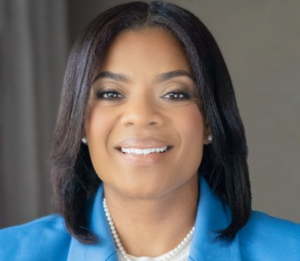
(BPRW) Spelman College Announces Alumna Salena Gray Jegede as Senior Vice President for Institutional Advancement (Black PR Wire) ATLANTA – Spelman College announced today the appointment of Salena Gray Jegede, C‘2003, as senior vice president for Institutional Advancement. Jegede, who previously served as the chief of donor advising for political organization Way to Win, will join Spelman […]

(BPRW) Spelman College Announces Alumna Salena Gray Jegede as Senior Vice President for Institutional Advancement | Press releases

(BPRW) Spelman College Announces Alumna Salena Gray Jegede as Senior Vice President for Institutional Advancement | Press releases

(BPRW) Spelman College Announces Alumna Salena Gray Jegede as Senior Vice President for Institutional Advancement (Black PR Wire) ATLANTA – Spelman College announced today the appointment of Salena Gray Jegede, C‘2003, as senior vice president for Institutional Advancement. Jegede, who previously served as the chief of donor advising for political organization Way to Win, will join Spelman […]

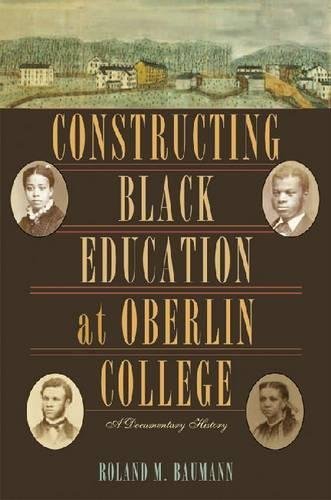
Constructing Black Education at Oberlin College: A Documentary History

Constructing Black Education at Oberlin College: A Documentary History

In 1835 Oberlin became the first institute of higher education to make a cause of racial egalitarianism when it decided to educate students “irrespective of color.” Yet the visionary college’s implementation of this admissions policy was uneven. In Constructing Black Education at Oberlin College: A Documentary History, Roland M. Baumann presents a comprehensive documentary history of the education of African American students at Oberlin College.

Following the Reconstruction era, Oberlin College mirrored the rest of society as it reduced its commitment to black students by treating them as less than equals of their white counterparts. By the middle of the twentieth century, black and white student activists partially reclaimed the Oberlin legacy by refusing to be defined by race. Generations of Oberlin students, plus a minority of faculty and staff, rekindled the college’s commitment to racial equality by 1970. In time, black separatism in its many forms replaced the integrationist ethic on campus as African Americans sought to chart their own destiny and advance curricular change.

Oberlin’s is not a story of unbroken progress, but rather of irony, of contradictions and integrity, of myth and reality, and of imperfections. Baumann takes readers directly to the original sources by including thirty complete documents from the Oberlin College Archives. This richly illustrated volume is an important contribution to the college’s 175th anniversary celebration of its distinguished history, for it convincinglydocuments how Oberlin wrestled over the meaning of race and the destiny of black people in American society.

ASIN ‏ : ‎ B006SU0LZK
Publisher ‏ : ‎ Ohio University Press; 1st edition (January 15, 2010)
Publication date ‏ : ‎ January 15, 2010
Language ‏ : ‎ English
File size ‏ : ‎ 5650 KB
Text-to-Speech ‏ : ‎ Enabled
Enhanced typesetting ‏ : ‎ Not Enabled
X-Ray ‏ : ‎ Not Enabled
Word Wise ‏ : ‎ Enabled
Sticky notes ‏ : ‎ Not Enabled
Print length ‏ : ‎ 472 pages

College Graduates Are Having A Harder Time Finding Work After The Pandemic

College Graduates Are Having A Harder Time Finding Work After The Pandemic

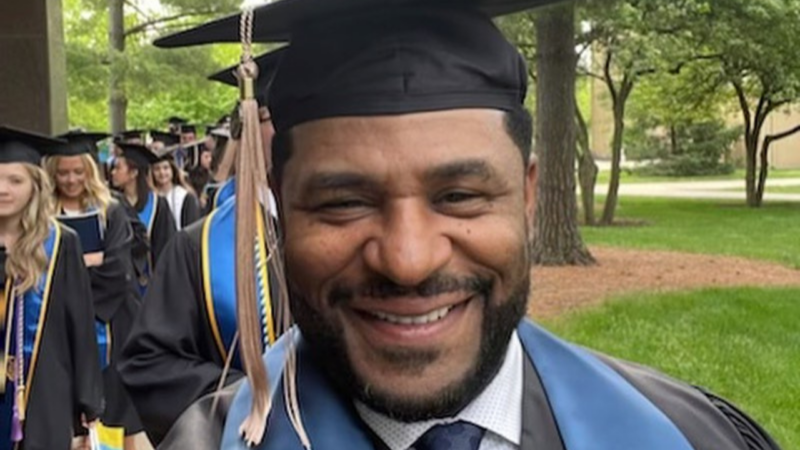
It is becoming increasingly difficult for recent college graduates to find employment. They are one of the brackets of the population struggling the most with their job search since January 2021. The unemployment rate for recent graduates is at 4.4 percent – a number higher than the overall jobless rate, according to the Federal Reserve […]