
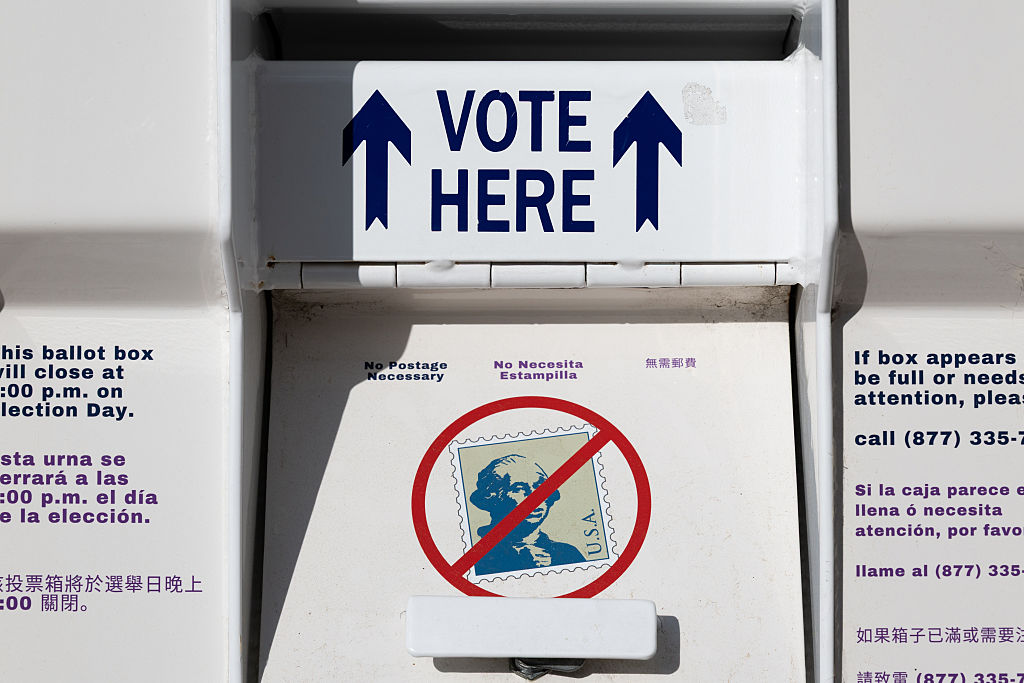
Supreme Court Narrowly Upholds Allowing Mail-In Ballots Received After Election Day

The U.S. Supreme Court ruled Monday that states may continue counting mail-in ballots postmarked by Election Day but received afterward, preserving states’ authority to enforce mail-in ballot grace periods ahead of major midterm elections this fall.
In a 5-4 decision, the justices upheld a Mississippi law allowing absentee ballots to be counted if they arrive within five business days after Election Day, according to SCOTUSblog. Justice Amy Coney Barrett wrote the majority opinion, joined by Chief Justice John Roberts and Justices Sonia Sotomayor, Elena Kagan and Ketanji Brown Jackson.
The case is connected to a challenge by the Republican National Committee, which argued that federal law requires ballots in federal elections to be received by Election Day. Writing for the majority, Barrett concluded that federal law establishes when Election Day occurs but does not bar states from counting ballots mailed on time that arrive later.
Who does the ruling affect?
The Washington Post reports that the ruling preserves mail-in ballot grace periods in multiple states, though not all. According to the Lawyers’ Committee for Civil Rights Under Law, jurisdictions that allow a grace period for all eligible voters include Alaska, California, the District of Columbia, Illinois, Maryland, Massachusetts, Mississippi, Nevada, New Jersey, New York, Oregon, Texas, Virginia, Washington, West Virginia, Puerto Rico, Guam and the U.S. Virgin Islands.
The organization also noted that 29 states accept some military and overseas ballots received after Election Day.
Why do grace periods matter?
Grace periods are intended to ensure voters are not disenfranchised because of postal delays beyond their control.
According to an amicus brief cited by the Lawyers’ Committee for Civil Rights Under Law, absentee voting accounted for about 31% of votes cast in 32 states during the 2024 election. The group said nearly 2 million Black voters, nearly 3 million Asian voters and more than 4 million Hispanic voters relied on mail-in ballots.
What the ruling means for the 2026 midterms
The decision removes uncertainty over mail-in ballot grace periods before this year’s midterm elections. Reuters reports that a ruling in the RNC’s favor could have forced states to stop counting ballots received after Election Day, even if they were mailed on time.
The case was closely watched by voting rights advocates. As Blavity previously reported, the legal challenge came amid Republican efforts to tighten mail-in voting rules ahead of the 2026 elections.
Voting rights advocates weigh in
Black Futures Lab said in a statement that the ruling is “a meaningful step toward protecting access to the ballot and ensuring that every eligible voter has a fair opportunity to participate in our democracy.” The organization also said there is no evidence of widespread voter fraud tied to mail-in voting and argued that expanding ballot access strengthens democracy.
Robert Weiner, director of the Voting Rights Project at the Lawyers’ Committee for Civil Rights Under Law, said the ruling rejects “yet another attempt to prevent eligible voters from casting their votes and having them counted.”
He said mail-in voting has become an important option for many Black voters because it can reduce transportation barriers, save time and help voters avoid potential intimidation at polling places.
Sen. Raphael Warnock also celebrated the ruling on X, emphasizing that it was a “small but significant victory” for voting rights.
The Lawyers’ Committee encouraged absentee voters to mail their ballots early, track their ballots and review their state’s voting rules before Election Day.
If you look at the history worldwide, Black people have contributed more than anybody else. They have contributed to almost Read more

The official version of Logic's "Soul Food" audio off his 'Under Pressure' album which is out now on Visionary Music Read more
For the 50 million kids who attend public schools in the US, the 2020 election is personal. Watch more 2020 Read more
In this clip from 1965, after leaving the Nation of Islam, Malcolm X appears on CBC-TV's 'Front Page Challenge' weeks Read more

I Have a Dream" is a public speech that was delivered by American civil rights activist Martin Luther King Jr. Read more

✪This one important person in Oprah Winfrey's life wanted nothing to do with her until she was famous. Years later, Read more

Relive the BEST OF Michael Jordan's playoff games through the years! Subscribe to the NBA: https://on.nba.com/2JX5gSN Full Game Highlights Playlist: Read more

The short film for Michael Jackson's ""Smooth Criminal"" was the centerpiece of the feature film Moonwalker, and featured the debut Read more


Paul Pierce and Zach Lowe join Rachel Nichols on The Jump for “Make or Miss,” to discuss Zach LaVine, Steph Read more

Watch the highlights of Serena Williams vs Simona Halep at Australian Open 2021. News from the #1 sports destination and Read more

Check out the Top-10 shots of Tiger Woods' career on the PGA TOUR (excluding majors), feature incredible putting, clutch hole Read more