

George Floyd’s Girlfriend Breaks Down In Tears During Trial As She Recalls How They Met
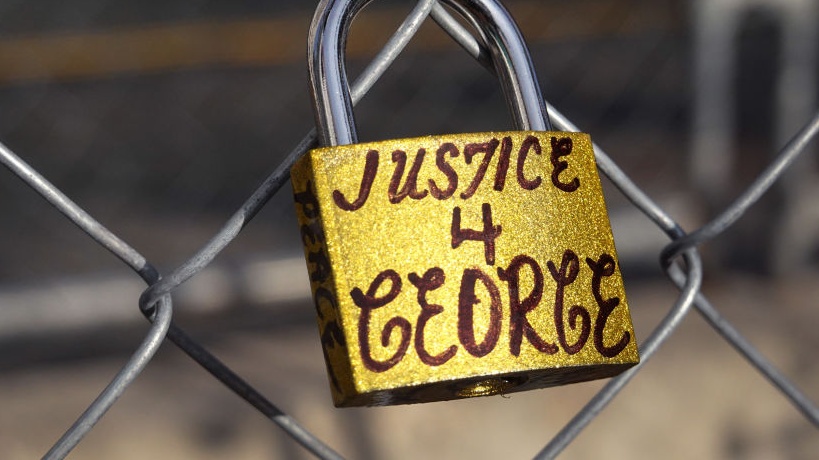
Courteney Ross, George Floyd‘s girlfriend, took the stand on Thursday in Derek Chauvin’s murder trial and spoke at length about their relationship as well as their struggles to overcome opioid addiction.
Ross spoke at length about how the two managed their opioid addiction that resulted from physical injuries, like many others across the country. The U.S. Department of Health estimated that in 2019, 10.1 million people ages 12 or older misused opioids.
Ross had pain in her neck that she was prescribed opioids for and Floyd had spent decades playing organized sports. As Blavity previously reported, Floyd was a decorated high school basketball and football player in Texas before attending Texas A&M University–Kingsville on a sports scholarship.
But he injured his back and struggled for years with pain in the lower section, Ross said.
“Floyd and I both suffered from an opioid addiction. Both Floyd and I, our story is a classic story of how many people get addicted to opioids. We both suffered from chronic pain, mine was in my neck and his was in his back. We both had prescriptions but after prescriptions that were filled, we got addicted. We tried really hard to break that addiction many times,” she told the court through tears.
Chauvin’s lawyers have repeatedly honed in on Floyd’s drug use and one of their main arguments is that Floyd died partially from the fentanyl and methamphetamine in his system as opposed to Chauvin’s knee, which was pressed down on Floyd’s neck for more than nine minutes.
In recent years, she said Floyd struggled with grief over his mother’s death and the two would at times relapse after recovering. After his mother died in 2018, he was “kind of a shell of himself, like he was kind of broken,” according to Ross.
“He didn’t have the same bounce that he had. He was devastated. He loved his mom so much. He talked about her all the time. I knew how he felt. It’s so hard to lose a parent that you love like that,” Ross said.
The two met in 2017 while Floyd worked as a security guard at the Salvation Army’s Harbor Light Center, a Minneapolis transitional housing facility.
Ross was going through a difficult time in her life and was crying in the lobby of the Salvation Army’s Harbor Light Center.
“Floyd had this great deep southern voice. Raspy. And he’s like, ‘Sis, you OK, sis?’ And I wasn’t OK. I said, ‘No, I’m just waiting for my son’s father. Sorry.’ He said, ‘Well, can I pray with you?’ I was so tired. We had been through so much, my sons and I. And this kind person, just to come up to me and say can I pray with you, when I felt alone in this lobby. It was so sweet. I had lost a lot of faith in God,” she said.
Because he was new to the city, she spent years showing him around Minneapolis and Minnesota, sharing a love of outdoor activities and food. Both also shared a love of children and she said he adored his children.
“Floyd liked to work out every single day, lifting weights. He did sit-ups, push-ups, pull-ups, just within his house. He would go biking…he loved playing neighborhood sports with kids. He was the type of person who would run to the store,” the 45-year-old said.
But even with how active the couple was, both struggled with chronic injuries that doctors told them should be dealt with through prescriptions for oxycontin and oxycodone.
“Addiction in my opinion is a lifelong struggle, so it’s something we dealt with every day. It’s not just something that comes and goes, it’s something I’ll deal with forever,” she added.
Mary Moriarty, a former chief public defender in Hennepin County, told KHOU11 that Ross’ testimony was key because until now, the public has not known why Floyd used drugs.
“We haven’t really known anything about why George Floyd was addicted to drugs. We haven’t known that at all. Now we know he had some chronic injuries. He tried prescription pills, and then – like many Americans – he became addicted to the painkillers,” she said.
“So the state is going to be arguing, yes, he had a high level of drugs in his system, but it didn’t kill him. It was Chauvin’s actions that did,” she said.
George Floyd’s girlfriend is testifying to their opioid use. So many families will identify w/the story of addiction as a result of chronic panic & the struggle to beat it, which isn’t a linear path. We should treat addiction as a public health issue, not a criminal justice one.
— Joyce Alene (@JoyceWhiteVance) April 1, 2021
The University of California, Los Angeles (UCLA) track and field and cross country team has announced that runner Chris Weiland was dismissed Read more

A New York man is melting the hearts of people on the internet after proposing to his girlfriend in the Read more

But the security going up around the Hennepin County courthouse, City Hall and the jail — all in the heart Read more

The George Floyd Justice in Policing Act of 2021 will make its way to the House floor on Wednesday for Read more

The U.S. House of Representatives passed the George Floyd Justice in Policing Act late on Wednesday with 220 votes. It will Read more

Nonprofit George Floyd Global Memorial (GFGM) and local organizers will be gathering on Monday for an interfaith Day of Global Read more
The trial of Derek Chauvin, which was scheduled for Monday, has been postponed to Tuesday while questions arise about the Read more

(BPRW) Court TV's Coverage Of The Death Of George Floyd Murder Trial Begins (Black PR Wire) MINNEAPOLIS - Court TV, Read more

The city council of Minneapolis has voted unanimously to settle a lawsuit filed by the family of George Floyd for Read more

MINNEAPOLIS (AP) — The city of Minneapolis on Friday agreed to pay $27 million to settle a civil lawsuit from Read more
Former University Of Kansas student Albert Wilson will get a new trial after Judge Sally Pokorny agreed that his court-appointed trial attorney Read more

Tiger Woods' ex-wife joined her Woods' girlfriend Erica Herman to support their son Charlie. Tiger Woods et son fils Charlie Read more