
Democrats Block GOP Constitutional Amendment To Cap Number Of Supreme Court Justices At 9
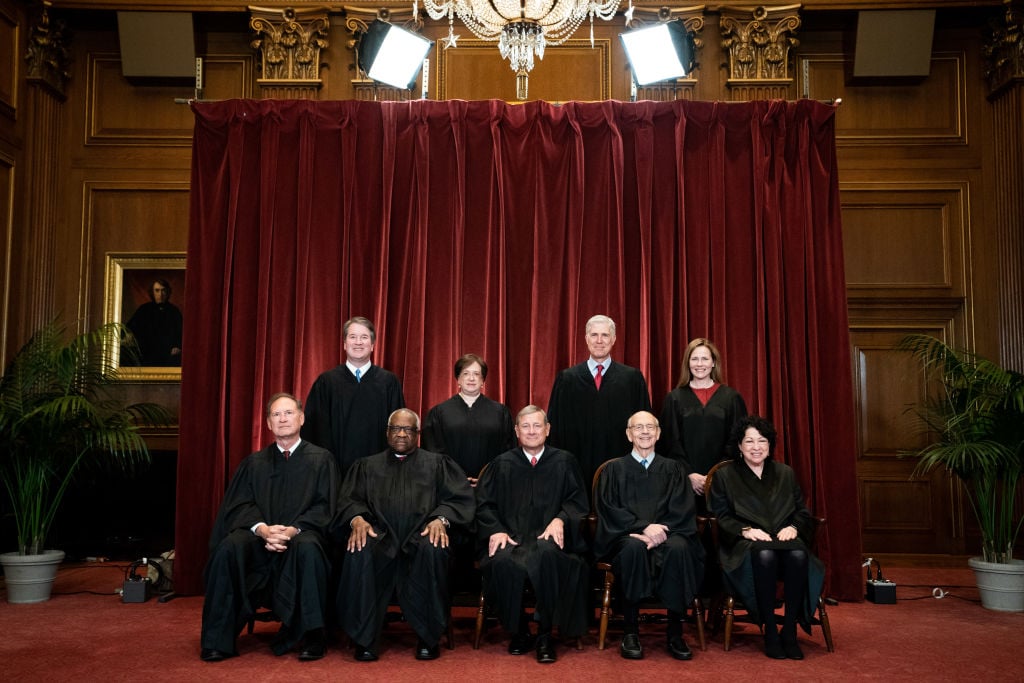
A move by Republicans to freeze the size of the Supreme Court failed in the U.S. House of Representatives on Wednesday. The push to pass a constitutional amendment concerning the court comes as Republicans seek to protect the conservative majority of the Supreme Court and Democrats explore ways to counter the dominance of GOP-appointed justices.
Amid frustration at conservative Supreme Court, Republicans look to block changes
As NBC News reported, Wednesday’s House vote on a Republican-backed amendment to permanently cap the size of the Supreme Court at 9 justices resulted in a 212-206 vote, with every Democrat but one opposing the measure. Although a majority of representatives approved of the measure, it fell well short of the two-thirds majority needed to advance constitutional amendments. The U.S. Constitution does not specify how many justices should serve on the Supreme Court, leaving it up to Congress to determine that number. The size of the Supreme Court has fluctuated since initially being set at six justices by the Judiciary Act of 1789, with the Court having as many as ten members at its largest size. The current structure of nine Supreme Court justices has been in place since 1869. The proposal put forth by Rep. Andy Biggs (R-Arizona) would add to the U.S. Constitution an amendment that reads “The Supreme Court of the United States shall be composed of nine justices consisting of one chief justice and eight associate justices,” thus permanently freezing the Supreme Court at its current size.
The push by Republicans to lock in the current structure of the Supreme Court comes as some Democrats have suggested expanding the court in order to add more liberal justices if Democrats retake Congress and the White House. The idea of expanding the court comes as Democrats grow frustrated with the court’s conservative supermajority, with 6 of the 9 current justices having been appointed by Republicans, including three appointed by President Trump. In recent years, the conservative majority of the court has struck down Roe v. Wade, ruled affirmative action in college admissions unconstitutional, expanded presidential immunity for President Trump and taken several steps to weaken voting rights and Black voting power, among other controversial rulings.
Democrats weigh Supreme Court changes as Republicans hope to control narrative
Amid these results and the prospect of the current conservatives continuing to dominate the court for years to come, some Democrats have proposed significant changes to the Supreme Court. Rep. Hakeem Jeffries (D-New York), the probable next Speaker of the House, recently told the National Association of Black Journalists that “dramatic Supreme Court reform is necessary,” declaring that “a variety of different options that are on the table. And I think that we can’t foreclose any single one of them.” Senate Democrats recently proposed a bill that would change the process of future Supreme Court appointments, making it so that one new justice would be appointed every 2 years for a term that would last 18 years, rather than the current lifetime appointments, thus creating regular rotation of justices.
Expanding the Supreme Court to include more than 9 justices, and thus allowing a future Democratic administration to dilute the power of the current conservatives on the court, is a suggestion that was once considered radical but is picking up support. Among potential 2028 Democratic presidential candidates, former Vice President Kamala Harris, former Secretary of Transportation Pete Buttigieg and New York Rep. Alexandria Ocasio-Cortez have all come out in favor of expanding the Supreme Court. Democratic Reps. Al Green of Texas and Jim Clyburn of South Carolina have specifically proposed expanding the Supreme Court to 13 justices. Republicans, however, believe that the idea of “court packing” can galvanize conservative voters. Wednesday’s vote appears to have been less about amending the Constitution — a very unlikely outcome — and more about making court expansion a talking point for the upcoming midterm elections. National Republican Congressional Committee spokesperson Mike Marinella immediately capitalized on Wednesday’s vote, saying Democrats struck down the proposed amendment “so they can follow through on a radical socialist agenda” by putting more liberals on the Supreme Court.
While amending the Constitution to freeze the Supreme Court’s size would require Republicans to clear extraordinary political hurdles, other reforms to the court could be accomplished by a simple majority vote in Congress. Whether or not Democrats gain the opportunity and develop the political will to expand the court, introduce term limits for justices, or change the Supreme Court in other ways, the prospects of such changes have already created a partisan divide that both parties hope will motivate voters in November and beyond.

If you look at the history worldwide, Black people have contributed more than anybody else. They have contributed to almost Read more

The official version of Logic's "Soul Food" audio off his 'Under Pressure' album which is out now on Visionary Music Read more

For the 50 million kids who attend public schools in the US, the 2020 election is personal. Watch more 2020 Read more

In this clip from 1965, after leaving the Nation of Islam, Malcolm X appears on CBC-TV's 'Front Page Challenge' weeks Read more

I Have a Dream" is a public speech that was delivered by American civil rights activist Martin Luther King Jr. Read more

✪This one important person in Oprah Winfrey's life wanted nothing to do with her until she was famous. Years later, Read more

Relive the BEST OF Michael Jordan's playoff games through the years! Subscribe to the NBA: https://on.nba.com/2JX5gSN Full Game Highlights Playlist: Read more

The short film for Michael Jackson's ""Smooth Criminal"" was the centerpiece of the feature film Moonwalker, and featured the debut Read more


Paul Pierce and Zach Lowe join Rachel Nichols on The Jump for “Make or Miss,” to discuss Zach LaVine, Steph Read more

Watch the highlights of Serena Williams vs Simona Halep at Australian Open 2021. News from the #1 sports destination and Read more

Check out the Top-10 shots of Tiger Woods' career on the PGA TOUR (excluding majors), feature incredible putting, clutch hole Read more