
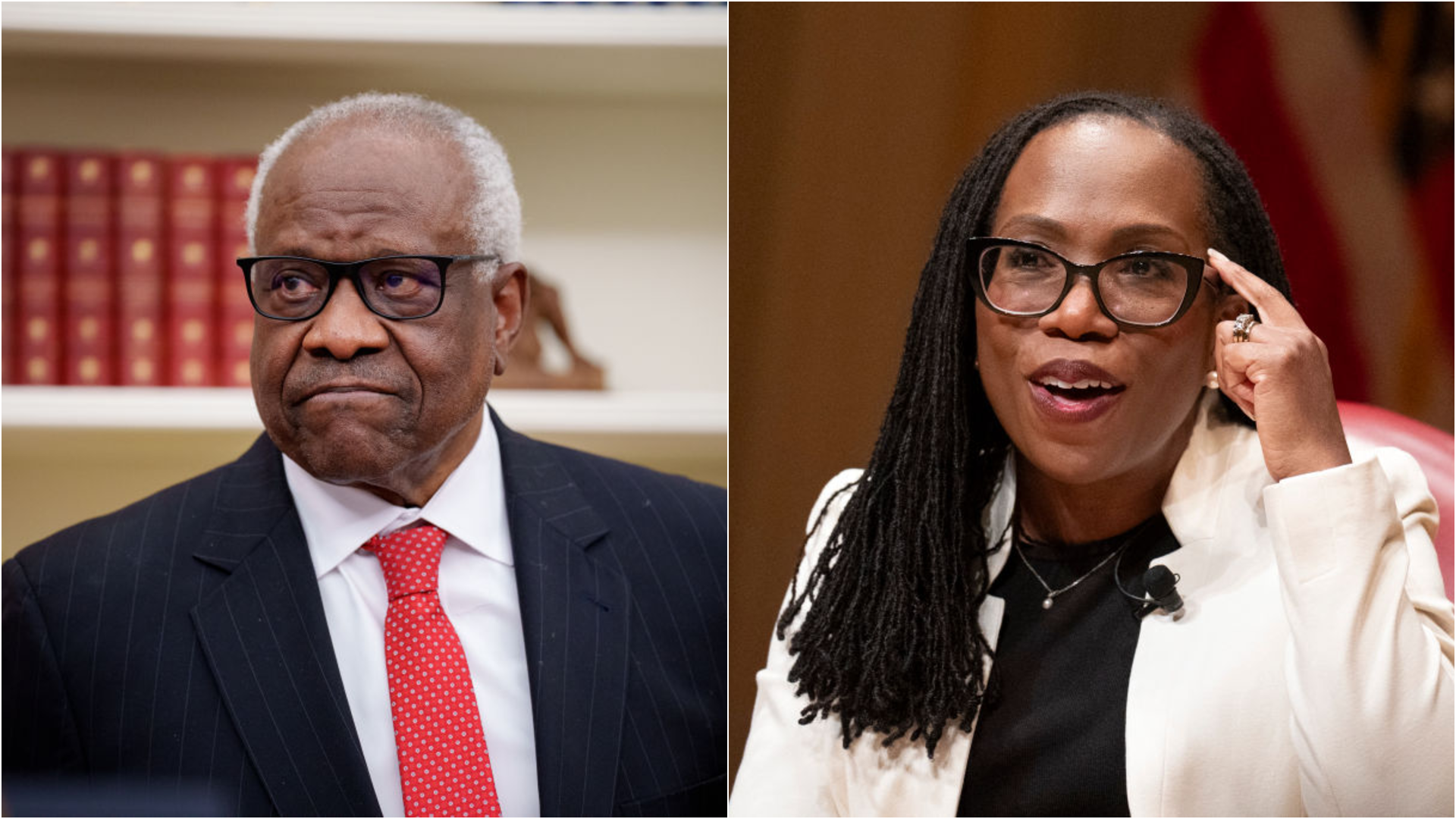
Clarence Thomas And Ketanji Brown Jackson Clash Over Race And Slavery In Birthright Citizenship Opinions

On the final day of the Supreme Court’s current session, the justices issued a landmark 6-3 ruling affirming birthright citizenship, the legal principle by which children born in the United States are automatically considered U.S. citizens. The ruling rejects an executive order issued by Trump that would have limited citizenship to cases in which at least one parent was already a citizen.
Supreme Court upholds citizenship ‘promise’ to ‘every free-born person in this land’
The Supreme Court ruled Tuesday to strike down a Trump executive order that sought to limit birthright citizenship, which Trump had pledged as part of his broader campaign to crack down on immigration.
Trump’s executive order, issued on his Inauguration Day in 2025, would deny citizenship to children born in the United States whose fathers were not citizens and whose mothers were either in the United States without authorization or were in the country temporarily, such as under student, tourist or work visas.
The order, which could have denied citizenship to hundreds of thousands of children born in the United States each year, was blocked by a federal judge and ruled unconstitutional by a federal appeals court, leading to the case being sent to the Supreme Court for a final decision.
The Supreme Court voted 6-3 to strike down Trump’s executive order and uphold birthright citizenship.
Writing for the majority, Chief Justice John Roberts said, “Citizenship, then and now, was the right to have rights — to freely participate in our political community.”
The chief justice argued that “The Framers of the Fourteenth Amendment extended that promise to ‘every free-born person in this land.’”
Roberts was joined by Justice Amy Coney Barrett, a Trump-appointed conservative, as well as the court’s liberal justices Ketanji Brown Jackson, Elena Kagan and Sonia Sotomayor.
Justice Brett Kavanaugh, another Trump appointee, argued that Trump’s order did not violate the Constitution but did violate a different federal law. That stance left open the possibility that Congress could pass a law, rather than a constitutional amendment, limiting birthright citizenship.
President Trump appeared to adopt that view as well, posting on social media, “Trump’s efforts to reverse birthright citizenship may succeed with or without SCOTUS:” along with a link to an article discussing the possibility of Congress passing legislation to limit birthright citizenship.
Court sides with precedent, as conservatives object
The principle of birthright citizenship in the United States is based on a clause in the 14th Amendment, one of the constitutional amendments passed after the Civil War.
The relevant clause reads, “All persons born or naturalized in the United States, and subject to the jurisdiction thereof, are citizens of the United States and of the State wherein they reside.”
The clause, ratified in 1868, has consistently been interpreted to mean that children born in the United States, with rare exceptions such as the children of diplomats, are automatically American citizens regardless of their parents’ immigration status.
Specifically, an 1898 Supreme Court ruling in United States v. Wong Kim Ark established that the 14th Amendment’s Citizenship Clause applies to nearly all children born in the United States.
Roberts wrote that the interpretation in Wong Kim Ark “was simple: the Citizenship Clause incorporated the common law and granted citizenship to nearly all children born in the United States. Not surprisingly, then, in the 128 years since, we have repeatedly understood the rule of Wong Kim Ark to guarantee citizenship to all children born in the United States and subject to its power.”
Three of the court’s conservative members — Justices Samuel Alito, Neil Gorsuch and Clarence Thomas — dissented, arguing that the Citizenship Clause was primarily meant for formerly enslaved Black Americans and their descendants.
“Blacks were entitled to citizenship because they were Americans. They had no other homeland, owed no allegiance to any foreign power, and were subject to no other authority,” Thomas wrote in dissent. “The same could not be said for the children of foreign temporary visitors.”
Justice Ketanji Brown Jackson, in her concurring opinion, took Thomas to task for his narrow interpretation of history.
“Despite his longstanding endorsement of a ‘colorblind’ Constitution, Justice Thomas now surprisingly suggests that the Citizenship Clause was a race-conscious remedial measure, relating only to ‘freed slaves such as Dred Scott,’” Jackson wrote.
She dismissed Thomas’ view, arguing that his “narrow vision of the Fourteenth Amendment bears little relationship to the history of its ratification.”
Referring to the Reconstruction era, Jackson accused Thomas of missing “the entire point of the Second Founding,” noting that “The Reconstruction Amendments were an anticaste, antisubordination reset for the Nation, not a mere spot treatment for the dark stain of slavery.”
Despite the skepticism expressed by some of the court’s conservative justices and the defiant response from President Trump, the Supreme Court upheld the principle of birthright citizenship as a constitutional right. The ruling strikes a significant blow to Trump’s restrictive immigration agenda. It also upholds a principle supported by many legal scholars and immigration advocates, and Jackson argued that the ruling conforms not only to the text of the 14th Amendment but also to the broader historical “reset” of the country after the Civil War.
If you look at the history worldwide, Black people have contributed more than anybody else. They have contributed to almost Read more
The official version of Logic's "Soul Food" audio off his 'Under Pressure' album which is out now on Visionary Music Read more
For the 50 million kids who attend public schools in the US, the 2020 election is personal. Watch more 2020 Read more
In this clip from 1965, after leaving the Nation of Islam, Malcolm X appears on CBC-TV's 'Front Page Challenge' weeks Read more

I Have a Dream" is a public speech that was delivered by American civil rights activist Martin Luther King Jr. Read more

✪This one important person in Oprah Winfrey's life wanted nothing to do with her until she was famous. Years later, Read more
Relive the BEST OF Michael Jordan's playoff games through the years! Subscribe to the NBA: https://on.nba.com/2JX5gSN Full Game Highlights Playlist: Read more
The short film for Michael Jackson's ""Smooth Criminal"" was the centerpiece of the feature film Moonwalker, and featured the debut Read more


Paul Pierce and Zach Lowe join Rachel Nichols on The Jump for “Make or Miss,” to discuss Zach LaVine, Steph Read more

Watch the highlights of Serena Williams vs Simona Halep at Australian Open 2021. News from the #1 sports destination and Read more
Check out the Top-10 shots of Tiger Woods' career on the PGA TOUR (excluding majors), feature incredible putting, clutch hole Read more