
US Supreme Court Rules Against Affirmative Action In College Admissions
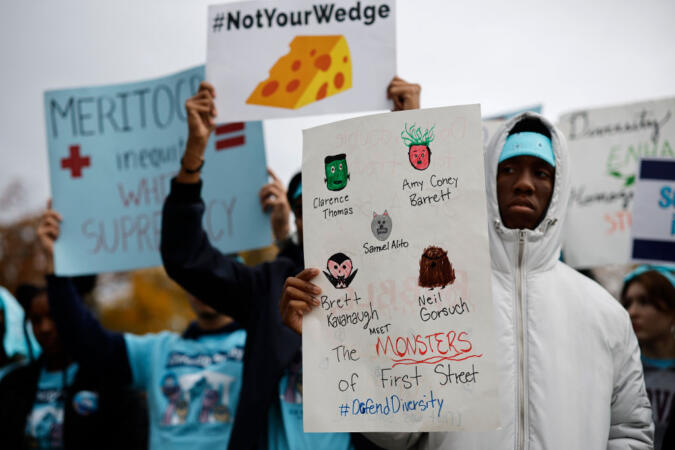
The decision on the UNC case was 6-3, with the court’s six conservative justices all voting to end affirmative action in college admissions and the three liberal justices voting to keep the policy. The decision for the Harvard case was 6-2 as Justice Ketanji Brown Jackson recused herself due to her previous ties to Harvard.
The majority ruling issued by the court claims race could still factor into admissions decisions in other ways, such as being incorporated into students’ admissions essays.
“Nothing prohibits universities from considering an applicant’s discussion of how race affected the applicant’s life, so long as that discussion is concretely tied to a quality of character or unique ability that the particular applicant can contribute to the university,” the ruling states.
Nevertheless, the liberal justices noted in their dissents that the impact of this decision would be felt deeply by racial minorities.
Justice Sonia Sotomayor says that in issuing this ruling, “the Court subverts the constitutional guarantee of equal protection by further entrenching racial inequality in education, the very foundation of our democratic government and pluralistic society.”
Justice Brown Jackson, meanwhile, was even harsher toward her conservative colleagues: “With let-them-eat-cake obliviousness, today, the majority pulls the ripcord and announces ‘colorblindness for all’ by legal fiat,” Brown Jackson wrote in her dissent. “But deeming race irrelevant in law does not make it so in life.”

This documentary examines the entirety of Michael Jordan's career. All of his slam dunks, legendary moments, game winners, buzzer beaters, Read more

Stephan A. Smith and Skip Bayless talk about the fair treatment between black and white coaches. source

14-year-old Dorothy Jean Tillman has been hunger for knowledge since a young age. “For me, I had always been really Read more

please subscribe to my channel to receive the movies posted on my channel and encouraged me to posted more movies Read more

Conflict erupts when a black student joins a college a cappella group that already has a black member. (Contains strong Read more

NBA player Jeremy Lin took to his Facebook account to push back on anti-Asian attacks that have been occurring throughout America, more Read more

According to News4Jax, the family said Nix had planned to meet his brother at his dad’s house on Tuesday. But Read more

From a distance, university education in the United States and Canada may not seem much different, considering that they are Read more

Cedric Richmond, President Joe Biden's senior adviser, sat down with journalist Mike Allen on HBO recently and addressed the continuous dialogue on reparations, Read more

Professors Joan Samuelson and Sampada Dalvi pay tribute to four black writers that influenced and inspired them. source

. Follow Me - Twitter: @RawSanity Tumblr: http://rawsanity.tumblr.com/ . . Comments disabled because the new comment system SUCKS! source

The Internet had a good laugh on Thursday when Lil Nas X responded to a homophobic insult from Tekashi69 by reminding Read more